
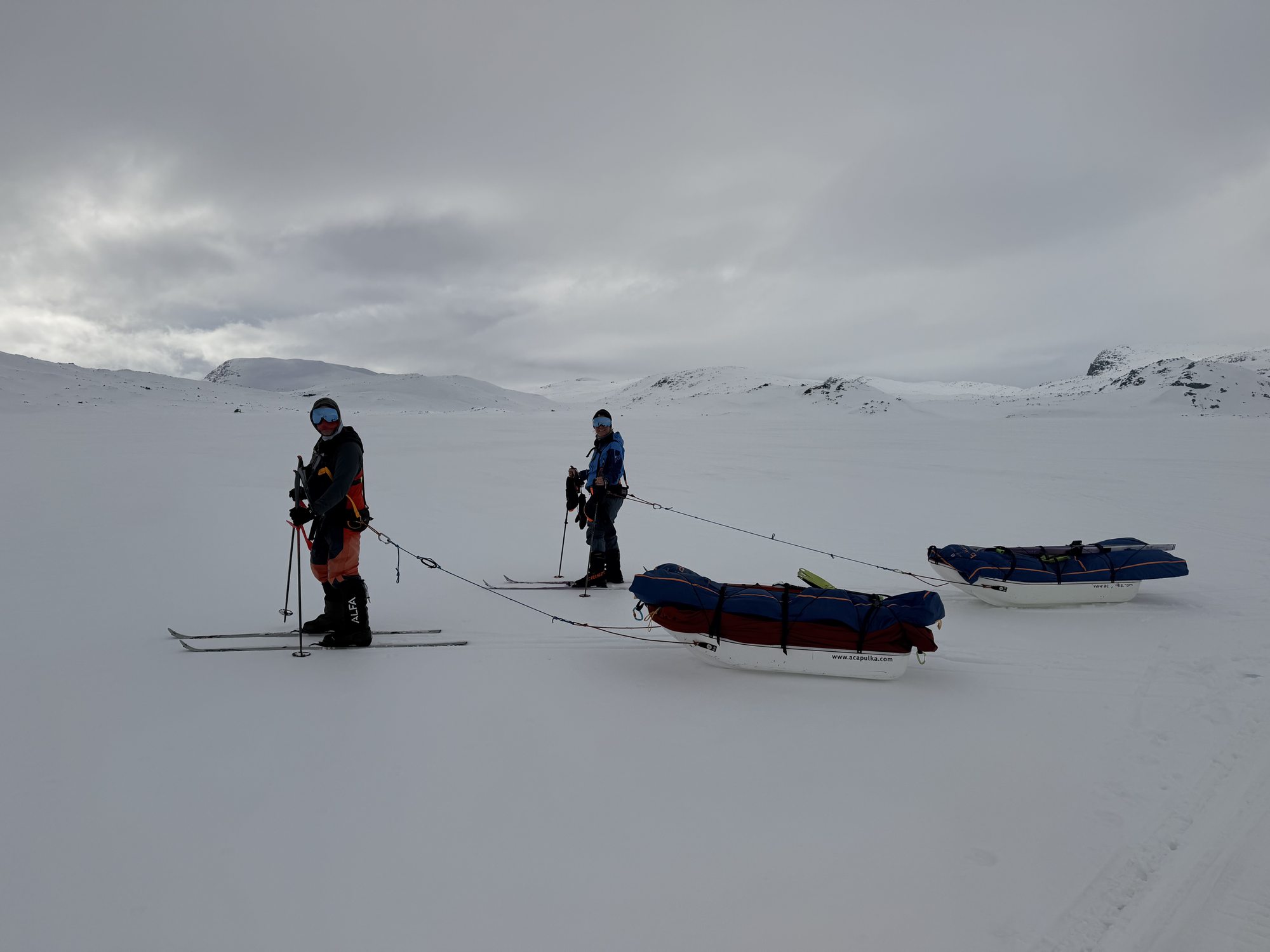
I (Erica) hadn’t really skied before I signed up to cross Antarctica — not recently, and not with any confidence. Ben had already learnt to cross-country ski, had done his polar survival training and a training expedition in Arctic Canada, had skied across Greenland, and had crossed Canada in winter by bike and ski.
The most important part of training is time on skis.
Antarctic Logistics & Expeditions (ALE), who fly independent teams onto the continent, set out three steps:
- Learn to ski.
- Polar survival training.
- At least a three-week unguided polar expedition, planned and run by the team itself, with no guide.
Ben has done all three. But we still need to do at least three weeks unguided together, as a team — and preferably more.
My time on skis so far
- Halti National Park, Arctic Finland, December 2025 – January 2026. Six days of hut-to-hut ski touring in the polar night at −40°C — my first time on cross-country skis and my first time pulling a pulk. We covered up to around 28km a day, and it was great training.
- Finse, Norway, February 2026. Two weeks of polar survival and expedition training with Hannah McKeand, including a seven-day training expedition across the Hardangervidda on skis. I got some great tips from Hannah on skiing, as well as everything else the course taught us.
- Hardangervidda, April 2026. Ben and I went back to Finse to borrow sleds, kit and a tent from Hannah, then set off on our own eight-day training expedition across the plateau and north of Finse. It was great experience — we skied well together, covered good distances at around 24km a day, and set up camp and cooked well, despite blizzards, whiteouts and strong winds.
- Oslo, April 2026. Three days of cross-country technique lessons, two of them in an indoor arena on racing skis. Excellent for technique.
Ben’s experience
Three weeks camped on the sea ice at Iqaluit in Arctic Canada in 2014, a crossing of the Greenland ice cap, 2,000km across Canada by bike and ski in winter, and 1,200km solo to the South Pole.
What counts as unguided, and what does not
Not every week on skis counts towards step three.
The seven days with Hannah on the Hardangervidda was led by a guide. It taught us an enormous amount, and it was not unguided.
Our own eight days in April were unguided — our own expedition, our own decisions, no guide. But the Hardangervidda is marked in winter with willow wands, set regularly enough that for long stretches you don’t navigate at all, you follow the markers. It was hard, cold and useful, and we learned a great deal about how we work as a pair under load. It is not the same as navigating for yourself.

The same is true of most accessible European ski terrain. Marked routes, mountain huts and other parties on the same ground are what make it accessible. They are also what make it poor preparation for a continent where none of those things exist.
March 2027: the Barren Grounds, Canada
In March 2027 we will spend four weeks unguided and unsupported on the Barren Grounds of the Northwest Territories and Nunavut, skiing from Łutsel K’e on the east arm of Great Slave Lake, north-east across the tundra towards Baker Lake.

The first stretch is lake ice. After that the treeline ends and does not come back. What follows is several hundred kilometres of open, treeless, lake-studded tundra, including the Thelon Wildlife Sanctuary — 52,000 square kilometres that sees fewer than a hundred visitors in a season.
There are no huts on that ground. No marked route, no trail, no cabins, no bail-out. Navigation is entirely on map, compass and GPS, across terrain with almost nothing on it to take a bearing from. March temperatures at Baker Lake average −22°C by day and −31°C by night, on exposed, wind-scoured ground.
It is also, deliberately, well inland. Polar bears in Canada are a coastal and sea-ice animal; there are none in the interior Northwest Territories. Barren-ground grizzlies den in late October and most do not emerge until the first week of May, so a March start sits inside the denning window.
Two things decided the route: somewhere with no route markings at all, so that every kilometre of navigation is ours — and no risk of bears. It is the closest thing to Antarctica we can reach: cold, flat, featureless, windy, empty, and entirely on us.
After that
We are also hoping to cross the Greenland ice cap in May 2027, subject to sponsorship and funding. Around 600km from Kangerlussuaq to the east coast, three to four weeks on the ice.
Then Antarctica in November.