
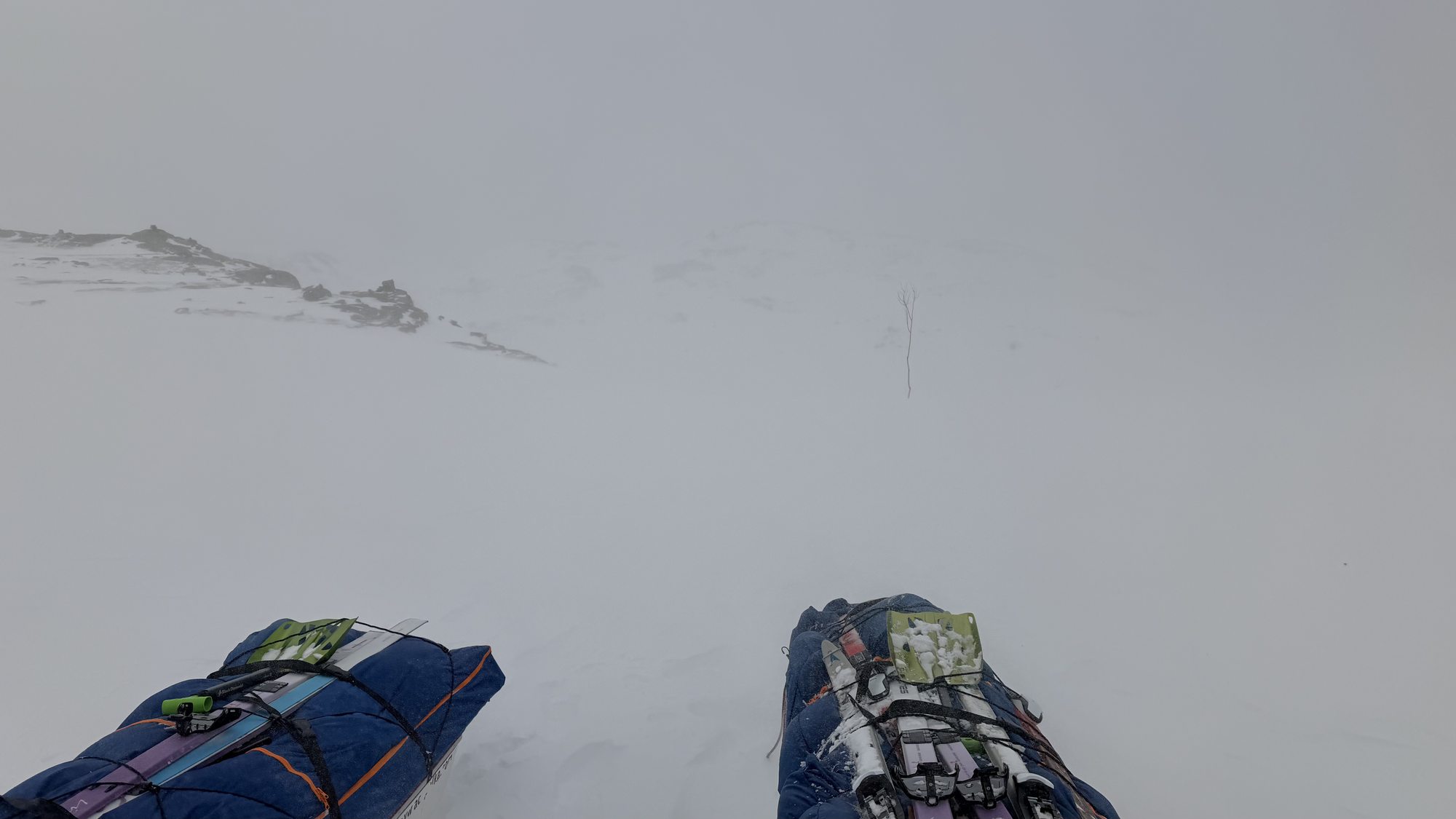
It’s like you’re skiing blindfolded… Like travelling in a pure white sphere. You don’t know how far you’re going or where you’re moving to. You can’t tell the difference between the snow beneath you and the sky above.
What are they, and what are the risks?
Whiteouts can create some of the most dangerous travel conditions for any adventurer. Particularly in the mountains and polar regions like Antarctica and the Arctic.
In whiteouts, the sky and snow-covered ground blend seamlessly, eliminating all sense of horizon. Depth perception literally reaches zero. Whiteouts can jeopardise safety, slow progress, and challenge even the most seasoned polar explorers.
In this and future posts, we will talk about what whiteouts are, how often they occur, and how we and other polar explorers can mitigate the risks.
What are whiteouts?

A common thought is that a whiteout is a blizzard. While blizzards can create whiteout conditions, whiteouts are not limited to them. Also, it doesn’t have to be windy for a whiteout to occur. It can be incredibly calm.
In essence, a whiteout is a near total or total loss of contrast.. They happen whenever there is a dense cloud layer or fog over an unbroken snow surface. The light becomes diffuse… evenly scattered, removing all definition and contrast. Falling or blowing snow can exacerbate the effect by filling the air with a swirl of white. The phenomenon can occur in any season. However, it is especially common during stormy or overcast periods. When Antarctica’s flat light and snow cover interact to create a seamless white backdrop.
Shadows disappear, the horizon vanishes, and it becomes nearly impossible to tell the sky from the ground. You can still see. But as there are no shadows, and everything is white, you cannot tell any differences in the snow below you or in the terrain ahead. It feels like you are blind. Unless there are dark rocks around. However, in Antarctica at least, you won’t find any of these once you are away from the mountains. They’re all buried under miles of thick ice. Explorers and others who have experienced it often compare it to being caught inside a featureless, milky void.
Under these conditions, a crevasse or a slight dip in the terrain can be hard to notice. It remains invisible until dangerously close. Indeed, in the mountains, it is all too common for people to walks off cliffs as they become impossible to distinguish. Ben Nevis, the UK’s tallest mountain, has had more than its fair share of accidents. And as Ben found out on his journey, sastrugi are practically invisible… until you’re falling off of them.
Where and how often in Antarctica do whiteouts occur?
Whiteouts can strike throughout any part of Antarctica, suddenly, and at any time. They’re not rare at all, though their frequency varies with local weather and geography. Coastal areas, including ice shelves, experience bouts of moist maritime air, leading to fog or overcast skies that can create “zero-contrast” conditions. Deep in the interior—the high Antarctic Plateau—strong winds can drive ground blizzards, resulting in whiteouts from blowing snow even under clear skies. Across the Antarctic, blizzard conditions leading to whiteouts can happen up to 30-60 days a year.
Veteran explorers anticipate multiple whiteout days during a typical expedition season. We can realistically expect at least 10-15 days or so with whiteout conditions in our coming expedition across the continent.
What risks do whiteouts pose?
Travelling through whiteout conditions can pose significant hazards. In the worst case, it can lead to accidents, such as not seeing when we’re on top of a crevasse or sastrugi. Other risks that Ben and other polar explorers have mentioned are:
Disorientation: Losing sense of direction and balance. Terrain features, including crevasses and sastrugi, become invisible often until it is too late.
Navigation Difficulties: In a whiteout, relying on visual cues becomes impossible. Minor navigational errors can quickly compound over the course of a day, leading teams kilometres off course. This can create a serious risk when trying to find safe corridors through crevasse fields.
Operational Hazards: Should we have an emergency, aircraft can’t land in the Antarctic if they have no visibility. Their engines can also clog with drifting snow.
Psychological Stress: Skiing blind for hours on end is demoralising. It can induce vertigo or illusionary movements and can affect judgement and morale. One of the feelings Ben had when skiing in whiteouts in Antarctica was the sense of going nowhere. Even dizziness as the spindrift passed over his skis.
Realistically, in the worst conditions we won’t be able to ski because of the safety issues. Especially if we are in known crevasse zones, or intense sastrgui fields. Should we be hit by any prolonged whiteout, we might have to spend days on end in our tiny (and most likely, smelly!) tent. Waiting for it to clear so we can go on again. All eating into our limited time available to complete the trek. Fingers crossed that won’t happen!!
More about mitigating the risks in the next post!
