
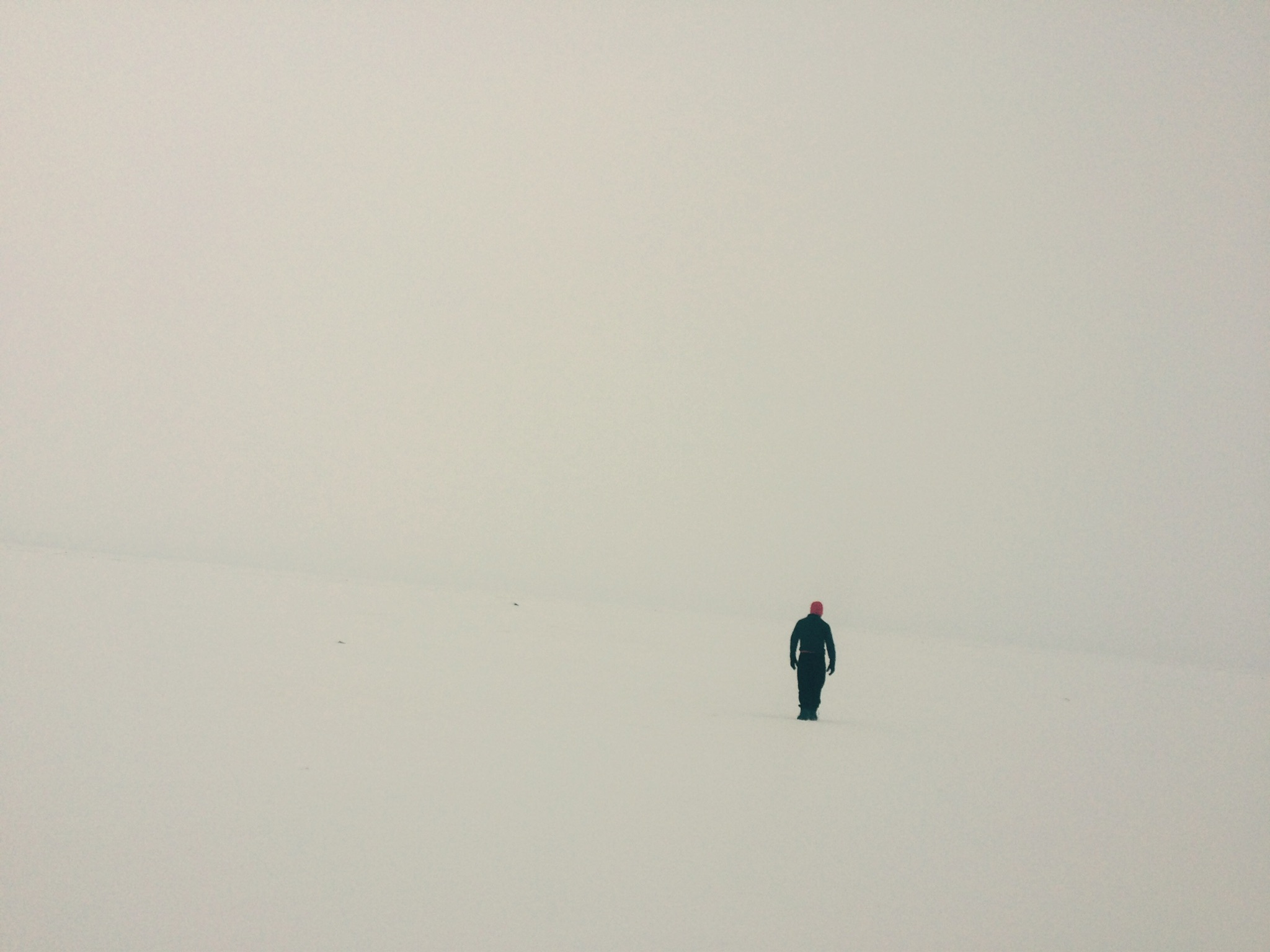
Where we will be most likely affected by whiteouts
Whiteouts can and do occur anywhere in Antarctica, and at any time. You just need some dense cloud and there you go! However, some places are more prone to them than others. Also, some areas will present greater risks to travel during whiteout conditions. Potential whiteout hot-spots on our route include:
- The Ronne–Filchner Ice Shelf Region near our start at Berkner Island can experience thick maritime fog and low cloud from the Weddell Sea.
- As we move inland and climb onto the Antarctic Plateau, whiteouts will be more likely due to wind-driven snow creating ground blizzards). Especially when sustained winds reach around ~25 knots or more.
- Similar to our starting point, as we travel across the Ross Ice Shelf and to the Bay of Whales, sudden low clouds, fog, sudden temperature shifts and and storm systems can sweep in from the Southern Ocean, creating whiteout conditions. This area is known for storms that can arrive with little warning. We’ll have to be extra careful here to not rush to finish even in bad conditions and when we’re already over exhausted.
Safety protocols and best practices in Antarctic whiteouts

Travelling through whiteouts is part and parcel of any polar expedition. It wouldn’t be possible to make the Pole (let alone the entire journey!) if we stopped every time there is a whiteout. One thing that will help is that there are two of us, especially when navigating.
When Ben was travelling alone to the Pole, he had to rely purely on looking down at his compass to make sure that he continued on the correct heading. It was so easy to veer off course. He would regularly need to check the GPS to double check. When there is a constant wind during the whiteout that made navigation much easier (we’ll write separate posts about navigating!!!). Just keeping the wind (which doesn’t regularly change direction like in the mountains) coming from the same direction and it would be fine.
But when the wind dropped… Yes, compass navigation. On one such day, Ben tried navigating using his watch compass due to neck problems (again, another post!), though it became even harder. The GPS track for that day made it look like he might have had a bit too much to drink! With two of us, we will still need to use the compass and GPS. However, the person behind will be able to shout to the person ahead when they see their heading change. That will definitely help! And both of us will have compasses (and a spare one each too), to keep checking.
However, in more dangerous regions, such as crevassed zones and sastrugi fields, more care is needed and other options need to be considered:
Crevassed zones
These areas are generally on the glaciers leading up and down from the Antarctic plateau. The plateau itself is largely devoid of these risks, though there are known risk areas en-route. The rigid ice cracks in these areas opens to form crevasses as it descends towards the sea. Some of the cracks are very narrow, while in some you can fit double-decker busses! Many of the fissures are covered over by snow-bridges (especially in early summer, after the long winter). These can (but not always) take our weight.


In good visibility we will be able to see the open fissures and also the changes in the snow that mark a depression of a snow-bridge. However, in a whiteout we won’t be able to distinguish anything at all, and GPS will not help. The positions of the crevasses are never fixed. We could easily walk straight into one of those giant crevasses and not realise until we start falling.
General safety in crevassed areas

We will be roped together when travelling through such areas, whatever the conditions – just like any mountaineering team. We will also have ice-axes and individual personal beacons for communication in case of emergency. Additionally, both of us will be prodding the snow with our ski poles. This is to make sure that the snow is solid and not the beginnings of a weak snow bridge. Or worse! When we setup camp, especially in whiteouts, we will need to check the area around our tent like this. Again, to make sure we’re not camping on top of, or near, a large crevasse!
Judgment calls…
Ultimately, we will have to judge by the context of what we had seen while the visibility had been good. We will also discuss with ALE, who conduct surveys of the different routes to see crevasse risk. However, in the most extreme conditions, we will need to stop, camp and wait.

Sastrugi fields
It is possible to navigate through sastrugi fields in whiteout conditions, but a lot of care is needed. It will also depend on how large the sastrugi are. In such areas, as you can’t see the sastrugi, you have to rely a lot on feel. You have to be able to feel your skis and whether they are moving on to what might be a sastrugi.
If not, and like Ben on his journey, we end up falling over six times in two hours, we will need to stop! Otherwise we will risk injury and also breaking equipment like bindings and ski poles. We will need to have spares of some of the most important gear to make sure we’re covered.
Also, as going around larger sastrugi can often involve significant detours, we will need to keep stopping to check our bearings more often in whiteout conditions.
How to plan around polar whiteouts
Ultimately, we just need to be prepared to spend time in the tent in the worst of the conditions. It could be for a few hours though even maybe days. We’ll have to use those times to repair any gear or just catch up on rest and sleep.